

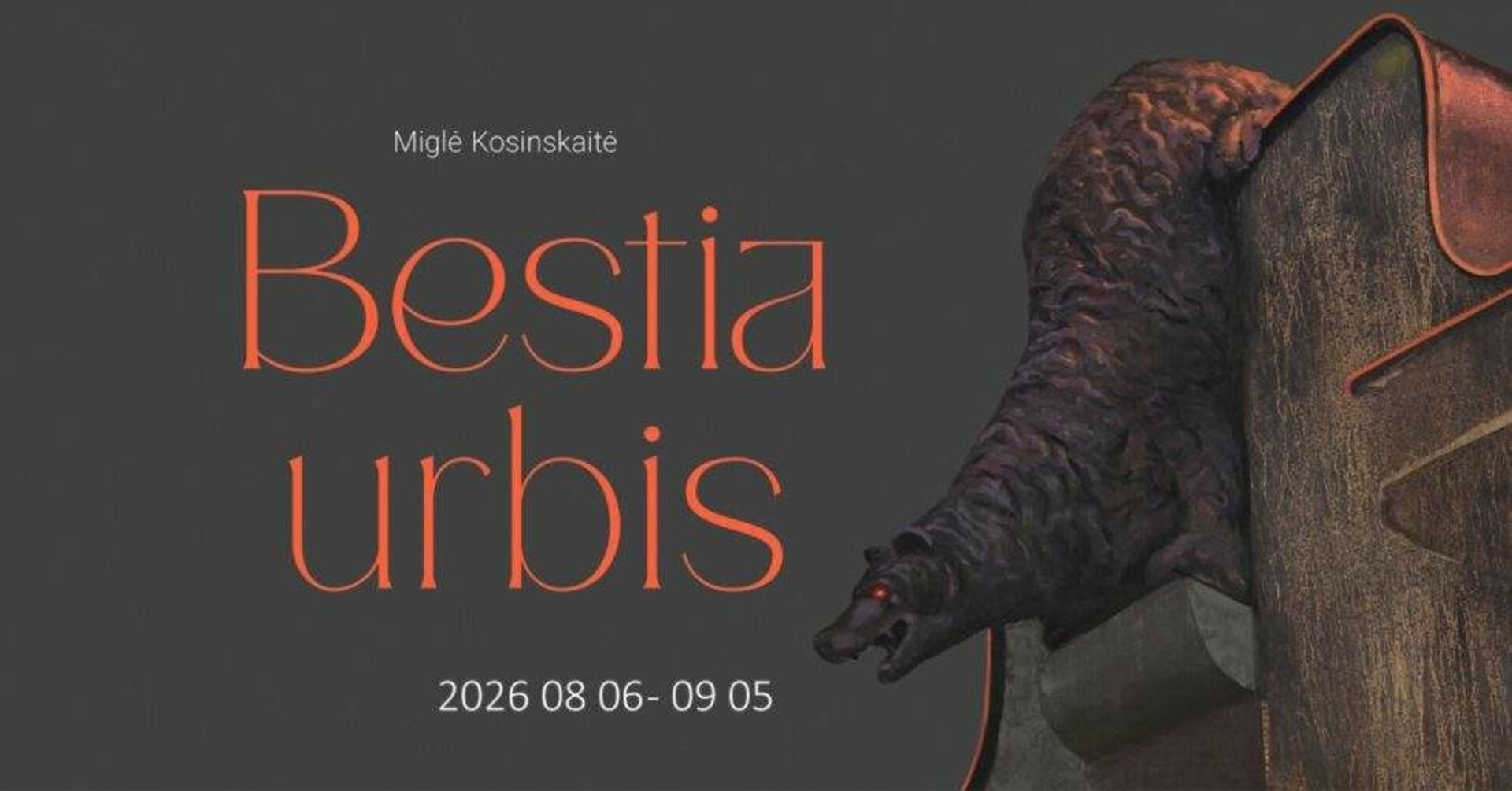
From 6 August to 5 September 2026, Miglė Kosinskaitė’s painting exhibition “Bestia Urbis” is on view at the Šiauliai Art Gallery.
The imaginary creatures in Miglė Kosinskaitė’s paintings sometimes resemble monuments, while the non-human inhabitants of this world, cast in bronze, stone or concrete, come to life at night. Allegorical figures of guardians and totems, as well as heraldic symbols in animal form, have long played an important role in urban architecture and the decoration of building façades. They are so familiar that we barely notice them. It is precisely towards these figures that the painter turns her gaze.
The bestia urbis species is numerous and diverse. Some of the beasts are encountered by chance during the artist’s travels, while others are well-known members of the community in the city where she lives. Dalia Matulaitė’s bronze sculpture The Bison, grazing in Ąžuolynas Park since 1979, is the heraldic symbol of the city of Kaunas transformed back into a large mammal. The famous lions of the Vytautas the Great War Museum, which guarded Astravas Manor near Biržai until 1938, were cast in iron in nineteenth-century Saint Petersburg at the request of Count Jonas Tiškevičius. They were donated to the museum by the count’s son, Jonas Jurgis Tiškevičius, the manor’s final heir. Concrete replicas now guard the entrance portal of Astravas Manor. People in Kaunas enjoy photographing children sitting astride the lions outside the museum. Miglė Kosinskaitė’s painting Eclipse resembles a photographic negative. The artist makes no secret of using photographs while painting, although metal beasts are probably the most patient of models.
The bears decorating the façade of the building at 2 Gedimino Avenue in Vilnius recall the confectionery shop run there by Izajas Bunimovičius in the early twentieth century. Two bears on the roof ridge guard an Art Nouveau architectural monument on Vytauto Street in Ukmergė. The house was built in 1913 by businesspeople Kazimieras and Teofilė Deveikiai. All its decoration was destroyed during the Soviet occupation. In 1999, the sculptor Mykolas Strioga (1931–2022), who had lived in Ukmergė since 1942, created approximate replicas of the bear reliefs using surviving photographs. The Strauss family of musicians lived in a house on the corner of Karmeliterplatz and Taborstraße in Vienna. Above the building’s bay window, in front of the attic windows, stands a copper stag created by the metalworker Emanuel Lankotsky. It is a copy of a figure that adorned the German pavilion at the International Hunting Exhibition in 1910.
The company is also joined by a cat carved by Ksenija Jaroševaitė from a sixteen-ton block of stone in memory of the writer Jurga Ivanauskaitė; a dog from Tallinn’s Rotermann Quarter; Mykolas Sauka’s eels; Donatas Jankauskas-Duonis’s monkey; hares from the Greek island of Samos; and concrete dinosaurs from Zarasai. Historical guardians of cities and ornaments of contemporary homes, sculptures by renowned artists and works by unknown apprentices, creatures both humble and powerful, comical and terrifying—all seemed to demand to be painted. One of them was invented by the artist. Can you guess which one?
— Erika Grigoravičienė
Share link by email