
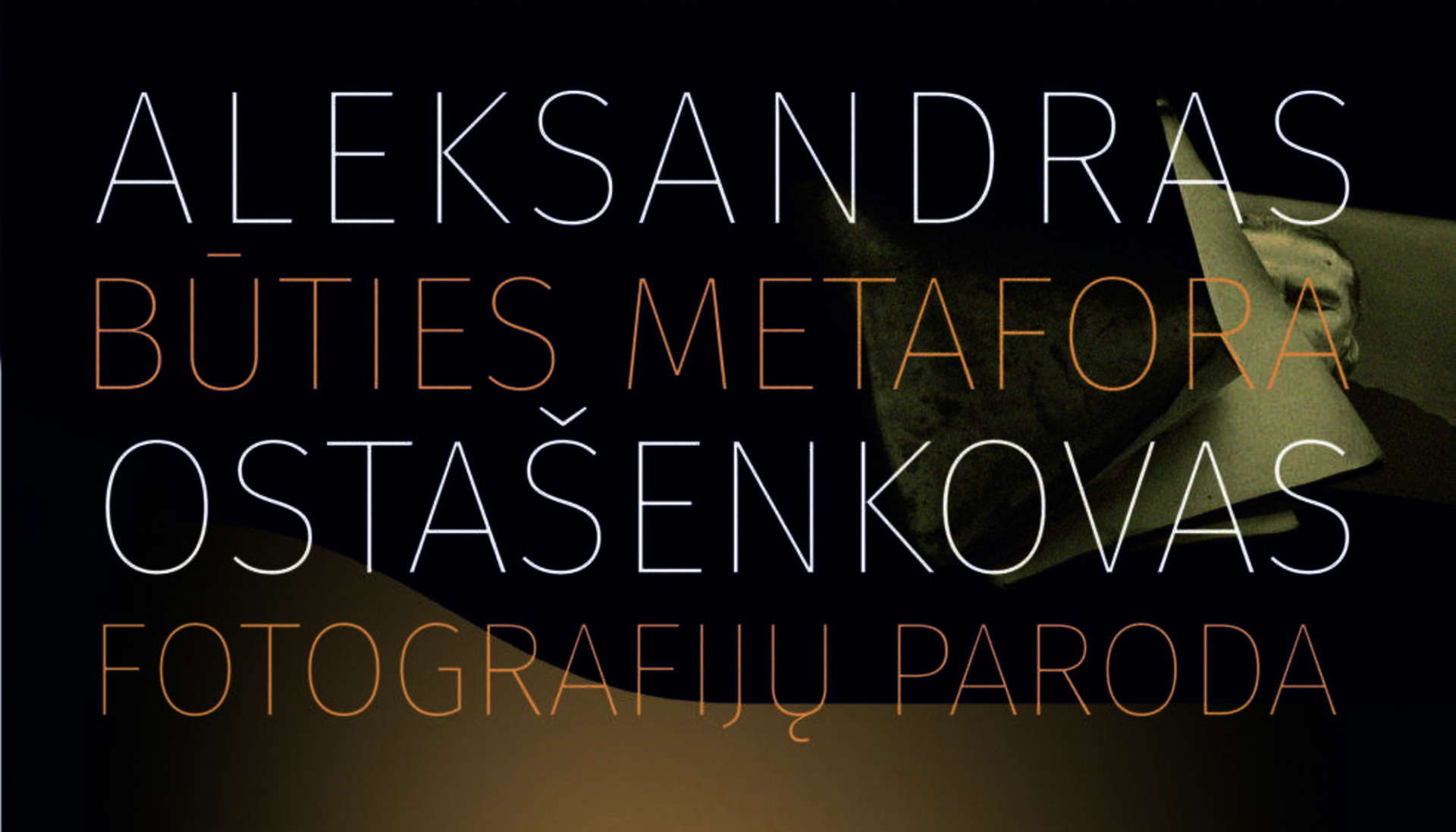
From October 9 to November 7, 2026, Aleksandras Ostašenkovas’ exhibition “Metaphor of Being” is on view at Šiauliai Art Gallery.
The exhibition opening will take place on Friday, October 9, at 5:00 PM. Admission is free during the opening event.
ABOUT THE EXHIBITION
Aleksandras Ostašenkovas’s exhibition “A Metaphor of Being” presents six photographic series spanning his work from 1968 to 2026: “Portrait of an Unnamed Time” (1968–2024), “The Other Shore” (1976–2004), “The Road to Memory” (1974–2024), “States” (1981–2015), “The Garden of Death” (2002–2008), and “My City” (2002–2026).
Created across different periods, these works are linked by themes of the transience of human existence, memory, and loss. In portraits, urban spaces, landscapes, and everyday details, the photographer seeks reflections of inner experience and observes the traces left by time. The reflections of authors who have written about the individual series offer further insight into this creative world.
“PORTRAIT OF AN UNNAMED TIME” (1968–2024)
“The photographer is drawn to people filled with restlessness and creative passion; he is able to capture a moment of concentration. Ostašenkovas favours close-ups and neutral backgrounds, accentuates the shape of the face and, most importantly, is able to convey the sitter’s inner state.”
Algirdas Gaižutis, “Ateinantys”, Literatūra ir menas, 1978.
“THE ROAD TO MEMORY” (1974–2024)
“Ostašenkovas’s photographs are philosophically poetic. He senses and understands that water and sky, earth and human skin each have their own structure: water ripples, the sky disperses clouds, the earth receives weary feet, and skin receives touch.”
Gintautas Mažeikis, “Ilgas kelias į svetimą atmintį. Aleksandro Ostašenkovo meninė fotografija”.
“THE OTHER SHORE” (1976–2004)
“Ostašenkovas has his own unmistakable style, a strong sense of aesthetic grace and restraint, and, at the same time, an exceptionally subtle grasp of the drama of existence. He is a poet of life’s fragility, transience, irreparable losses, and nostalgic tension. A voice expressing painful truths about Life and Humanity…”
Dalia Striogaitė, “Aleksandro Ostašenkovo ‘Prisiminimai’”, Šiaulių naujienos, 1992.
“STATES” (1981–2015)
“Such photography is like an imagined space of silence in which, as the artist himself says, meaning is born. In Ostašenkovas’s work, a minimal change, often unnoticed in everyday life, conveys, on an existential level, the very essence of being and its transience. This essence may be contained, for example, in a barely perceptible change in natural light: sunlight illuminating the foliage of trees becomes an unnameable, intangible expression of being—and, precisely for that reason, its purest expression…”
Tomas Pabedinskas, “Laiko tėkmė”, Krantai, 2016.
“THE GARDEN OF DEATH” (2002–2008)
“The artist does not teach us how to look at death. What is death? It is merely a threshold shifting in an unknown direction. It is merely a passage. It is merely a mystery that has found its own voice. Perhaps, at the artist’s invitation, we might enter and linger for a moment in the stillness of this garden of death, in its expressive luminosity…”
Jurgis Dieliautas, Kultūros kontekstai: filosofija, menas, ugdymas, 2009.
“MY CITY” (2002–2026)
“Ostašenkovas goes out to photograph the city when it is shrouded in fog. Fog not only softens but also conceals. If it conceals, then why? So that what is harder to grasp may remain, so that the sounds of the city do not prevent us from hearing the silence of being.”
Agnė Narušytė, “Po Aleksandro Ostašenkovo miestą”, in the photography book Mano miestas, 2006.
_ _ _
Exhibition organisers: Šiauliai Art Gallery and the Visual Artists’ Association
The project is partially funded by Šiauliai City Municipality
Share link by email